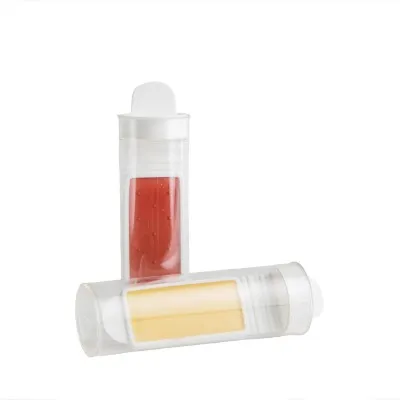

PC2TN Plate Count Agar Dipslides with TTC (Red spot dye)

Gem Scientific

PC2TN Plate Count Agar Dipslides with TTC (Red spot dye)

Neutralizers for common disinfectants
Quantity

The minimum purchase order quantity for the product is 10.

  • Slide Format: Large Pushfit
  • Agar (Side 1): Plate Count + Neutralisers + Ttc
  • Detection (Side 1): Total Count
  • Agar (Side 2): Plate Count + Neutralisers + Ttc
  • Detection (Side 2): Total Count
  • Shelf Life: 6 Months
  • Storage Temp.: 8 - 15 C
  • Incubation: 35 C - 24 - 48 Hrs
  • 10 Dipslides per box
  • Minimum Order Quantity: 10 boxes
Go to Product Description

ASK A QUESTION

Please fill in the form below to ask a question about this product:

  100% Secure Shopping

100% Secure Shopping & Payment Gateway

  Express Delivery

We aim to ship all stocked items within 1-3 working days.

  Hassle Free Returns

Not 100% happy with your order? find out more about our returns policy.

Gem Scientific plate count agar with TTC (Red spot dye) and neutralisers for common disinfectants. Improved recovery of bacteria damaged but not killed by cleaning chemicals. For general use

  • Slide Format: Large Pushfit
  • Agar (Side 1): Plate Count + Neutralisers + Ttc
  • Detection (Side 1): Total Count
  • Agar (Side 2): Plate Count + Neutralisers + Ttc
  • Detection (Side 2): Total Count
  • Shelf Life: 6 Months
  • Storage Temp.: 8 - 15 C
  • Incubation: 35 C - 24 - 48 Hrs
  • 10 Dipslides per box
  • Minimum Order Quantity: 10 boxes

The media that Gem Scientific use is designed to not only provide you with the most accurate results but visually distinctive dependent on the product type and the level of bacteria found at the original testing location

Within each box of Gem Scientific dip slides is a handy comparison chart to demonstrate what level of contamination the tested area has. This is measured by the coverage of the media by the bacteria recovered from the sample or area tested. Regular testing is recommended to ensure your regimes are being maintained and bacteria levels are as low as possible.

Storage

Store in a cool dry place (Optimum 8-15oC) and use before the expiry date on the box. Do not use slides if there is any sign of growth before opening. Slides remain usable while the agar is smooth and attached to the slide. A small amount of water may collect at the bottom of the tube. This is condensate from the agar and does not affect performance, provided the agar still fills the tray.

Disposal

Used slides should be incinerated, autoclaved or soaked in disinfectant for several hours before disposal.

DIM-PC2TN

Our standard delivery is 3-5 working days (where products are available) Monday to Friday, excluding public holidays when you order by 2pm. Details of our returns and cancellation policy can be found in our Returns Policy & Section 11 of our Terms and Conditions. For more information please contact us on 01924 444 577 or Email Us.

16 other products in the same category:

Simmons Citrate Agar - 500 g

£137.55 vat excl.

£165.06 vat Inc.

Availability: Out of stock
Simmons Citrate Agar is used for the differentiation of microorganisms on the basis of citrate utilization in a laboratory setting. Simmons Citrate Agar is not intended for use in the diagnosis of disease or other conditions in humans. Koser first developed a liquid medium for differentiating coliforms from fecal coliforms. Fecal coliforms were unable to use citrate as the sole source of carbon and inorganic ammonium salt as a sole source of nitrogen. Non-fecal coliforms, such as Enterobacter aerogenes could use citrate in such a medium with resultant alkalinity. Liquid medium had the disadvantage of appearing turbid when a large inoculum was used, although no growth had taken place. This observation led Simmons to devise a solid medium that eliminated the problem with turbidity. Simmons Citrate Agar is a modification of Koser’s medium, with the addition of bromothymol blue and 1.5% agar. Organisms able to metabolize citrate grow luxuriantly. The medium is alkalinized and changes from green to deep blue in 24 – 48 hours. Escherichia coli either do not grow at all on this medium or grow so sparsely that no change in reaction is apparent. Simmons Citrate Agar is recommended for differentiation of enteric Gram-negative bacilli from laboratory specimens, water samples, and food samples.

TT2 CLED and MacConkey (w/o salt) Agar Dipslides

£11.69 vat excl.

£14.03 vat Inc.

Availability: 34 In Stock
  • Slide Format: Large Pushfit
  • Agar (Side 1): Cled
  • Detection (Side 1): Total Count 
  • Agar (Side 2): Mac Conkey W/O Salt
  • Detection (Side 2): Coliforms
  • Shelf Life: 9 Months
  • Storage Temp.: 8 - 15 ℃
  • Incubation: 35 ℃ - 24 - 48 Hrs
  • 10 Dipslides per box
  • Minimum Order Quantity: 50 box

Agar - Bacteriological No. 1

£1,606.08 vat excl.

£1,927.30 vat Inc.

Availability: Out of stock
Agar, Bacteriological No. 1 is a solidifying agent for use in preparing microbiological culture media in a laboratory setting. Agar, Bacteriological No. 1 is not intended for use in the diagnosis of disease or other conditions in humans. Agar, Bacteriological No. 1 conforms with the testing specified in the USP/EP Pharmacopeia. Agar is a phycocolloid extracted from a group of red-purple algae, usually Gelidium spp. Agar was first suggested for microbiological purposes in 1881 by Fannie Hesse. By the early 1900’s, agar became the gelling agent of choice over gelatin because agar remains firm at growth temperature for many pathogens and agar is generally resistant to a breakdown by bacterial enzymes. The use of agar in microbiological media significantly contributed to the advance of microbiology, paving the way to study pure cultures. Agar is a gel at room temperature, remaining firm at temperatures as high as 65°C. Agar melts at approximately 85 - 91°C, a different temperature from solidification at 34 - 36°C. This property is known as hysteresis. Agar is generally resistant to shear forces; however, different agar may have different gel strengths or degrees of stiffness. Specifications for Agar, Bacteriological No. 1 include good clarity, controlled gelation temperature, controlled melting temperature, good diffusion characteristics, absence of toxic bacterial inhibitors, and relative absence metabolically useful minerals and compounds. Agar, Bacteriological No. 1 is recommended for clinical applications, auxotrophic studies, bacterial and yeast transformation studies, and bacterial molecular genetics applications.

BV Baird Parker and VRBG Agar Dipslides

£10.09 vat excl.

£12.11 vat Inc.
Availability: 43 In Stock
  • Slide Format: Large Pushfit
  • Agar (Side 1): Baird Parker
  • Detection (Side 1): Staphylococci
  • Agar (Side 2): VRBGA
  • Detection (Side 2): Enterobacteriacea
  • Shelf Life: 9 Months
  • Storage Temp.: 8 - 15 C
  • Incubation: 35 C - 24 - 48 Hrs
  • 10 Dipslides per box
  • Minimum Order Quantity: 1 box