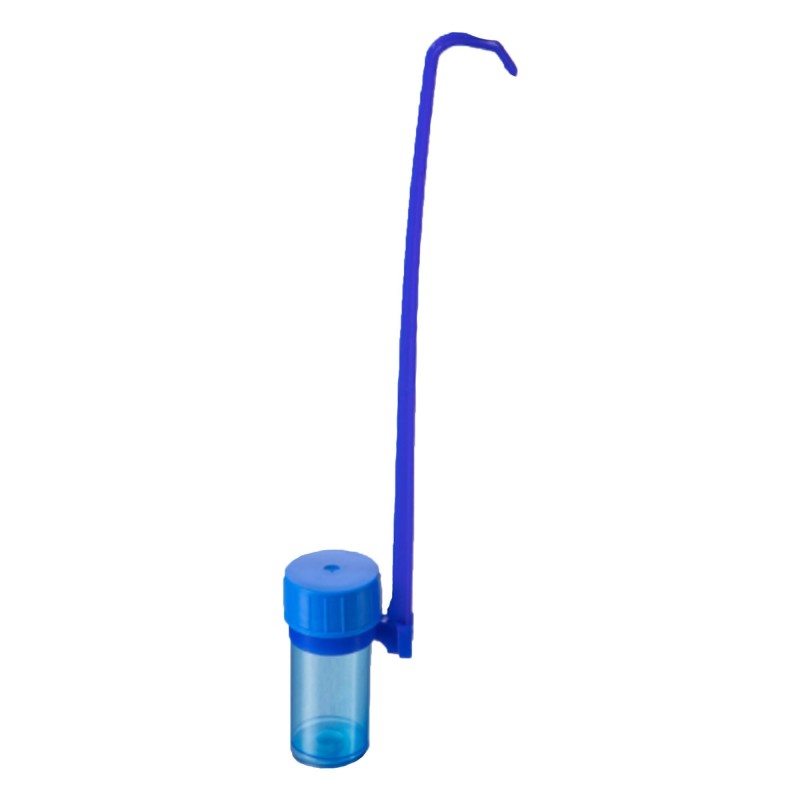


Gosselin™ Dipper, 40 ml, with Removable Handle, Blue PP

Corning

Gosselin™ Dipper, 40 ml, with Removable Handle, Blue PP

With Blue Screw Cap, Sterile, 1/Bag, 250/Case
Quantity

  • Dippers with removable handle
  • 40 ml Capacity
  • Blue Polypropylene (PP) containers
  • Removable handle
  • Tamper-evident, single resealable plastic bag
  • Sampling/collection - 250 / Case
Go to Product Description

ASK A QUESTION

Please fill in the form below to ask a question about this product:

  100% Secure Shopping

100% Secure Shopping & Payment Gateway

  Express Delivery

We aim to ship all stocked items within 1-3 working days.

  Hassle Free Returns

Not 100% happy with your order? find out more about our returns policy.

  • Dippers with removable handle
  • 40 ml Capacity
  • Blue Polypropylene (PP) containers
  • Removable handle
  • Tamper-evident, single resealable plastic bag
  • Sampling/collection - 250 / Case
PGTAT30C-01

Our standard delivery is 3-5 working days (where products are available) Monday to Friday, excluding public holidays when you order by 2pm. Details of our returns and cancellation policy can be found in our Returns Policy & Section 11 of our Terms and Conditions. For more information please contact us on 01924 444 577 or Email Us.

16 other products in the same category:

Campy Blood-Free Selective Medium (Modified CCDA) - 500 g

£99.00 vat excl.

£118.80 vat Inc.

Availability: Out of stock
Campy Blood-Free Selective Medium (CCDA) is used with cefoperazone for the selective isolation of Campylobacter spp. in a laboratory setting. Campy Blood-Free Selective Medium (CCDA) is not intended for use in the diagnosis of disease or other conditions in humans Campy Blood-Free Selective Medium (CCDA) was described by Bolton et al. This medium was formulated to replace blood with charcoal, ferrous sulfate, and sodium pyruvate. To improve selectivity, cefoperazone replaced cephazolin in the original formulation. Bolton et al recommended incubating inoculated plates at 37°C to improve isolation rates. Yeast and fungal contaminants are inhibited with the addition of amphotericin B. Campy Blood- Free Selective Medium (CCDA) is recommended for food testing.
Availability: Out of stock
Thiosulfate Citrate Bile Salts Sucrose (TCBS) Agar is used for the selective isolation of Vibrio cholerae and other enteropathogenic vibrios according to ISO 21872-1:2017 and ISO 21872-2:2007. Thiosulfate Citrate Bile Salts Sucrose (TCBS) Agar is not intended for use in the diagnosis of disease or other conditions in humans. TCBS Agar is also called Vibrio Selective Agar, and prepared according to the formula of Kobayashi et al. This formula is a modification of the selective medium from Nakanishi. All pathogenic Vibrio spp., except Vibrio hollisae, will grow on TCBS Agar. This highly selective agar meets the nutritional requirements of Vibrio spp. Vibrio spp. are able to grow in media containing increased salt concentrations, and some species are halophilic. Infections have been associated with ingestion of contaminated water and consumption of contaminated shellfish or seafood. Vibrio spp. are natural inhabitants of seawater. According to ISO 21872-2, pre-incubation in Alkaline Saline Peptone Water (ASPW) (NCM0175) is required.

50ml Centrifuge tube (Pack of 450)

£78.74 vat excl.

£94.49 vat Inc.

Availability: 2 In Stock
  • 50ml Centrifuge tube
  • Sterile
  • Polypropylene displays high thermal, mechanical and chemical resistance. It is therefore recommended for the storage of chemical and biological samples
  • Diameter: 30 mm; height: 115 mm
  • With blue screw cap
  • With blue graduation and white writing area
  • With support skirt
  • Quantity: 450

Lauryl Sulfate Broth

£519.48 vat excl.

£623.38 vat Inc.

Availability: Out of stock
Lauryl Sulfate Broth is used for the detection of coliform bacteria in water and wastewater in a laboratory setting. Lauryl Sulfate Broth is not intended for use in the diagnosis of disease or other conditions in humans. The coliform group of bacteria includes aerobic and facultative anaerobic, Gram-negative, non-sporeforming bacilli that ferment lactose and form acid and gas at 35°C within 48 hours. Members of the Enterobacteriacae comprise the majority of this group, but organisms such as Aeromonas spp. may also be included. Procedures to detect and confirm coliforms are used in testing water, foods, dairy products, and other materials. Lauryl Sulfate Broth, also referred to as Lauryl Tryptose Broth, is prepared according to the formula of Mallmann and Darby. During their investigation, Sodium Lauryl Sulfate produced the best results for inhibition of organisms other than coliforms. Lauryl Sulfate Broth, abbreviated as LSB, is used in the presumptive phase of the Standard Total Coliform Fermentation Technique in the examination of water, and coliform detection of foods.

MacConkey Agar No. 3

£2,142.21 vat excl.

£2,570.65 vat Inc.

Availability: Out of stock
MacConkey Agar No. 3 is used for the cultivation of Enterobacteriaceae. A modification recommended by the W.H.O. and the American Public Health Association for the isolation of Enterobacteriaceae from waters and sewage.

TF3 Nutrient Agar with TTC (Red spot dye) Dipslides

£10.09 vat excl.

£12.11 vat Inc.

Availability: 50 In Stock
  • Slide Format: Small Screwcap
  • Agar (Side 1): Nutrient + Ttc
  • Detection (Side 1): Total Count 
  • Agar (Side 2): Wort Agar With Rose Bengal
  • Detection (Side 2): Yeast and Moulds
  • Shelf Life: 9 Months
  • Storage Temp.: 8 - 15 C
  • Incubation: 30 C - 24 - 120 Hrs
  • 10 Dipslides per box
  • Minimum Order Quantity: 1 box

Fraser Broth Base

£2,027.90 vat excl.

£2,433.48 vat Inc.

Availability: Out of stock
Fraser Broth Base is used with Acriflavin, Nalidixic Acid, and Ferric Ammonium Citrate for the selective enrichment of Listeria spp. Fraser Broth Base is not intended for use in the diagnosis of disease or other conditions in humans. Formulated according to MLG Appendix 1.09 (for the ISO 11290 formulation please use NCM0001). Listeria monocytogenes, described first in 1926 by Murray, Webb, and Swann, is an extensive problem in public health and food industries. This organism has the ability to cause human illness and death, particularly in immunocompromised individuals and pregnant women. Epidemiological evidence from outbreaks of listeriosis indicated the principle route of transmission is via the consumption of foodstuffs contaminated with Listeria monocytogenes. Implicated vehicles of transmission include turkey frankfurters, coleslaw, pasteurized milk, Mexican style cheese and pate. Half Fraser (Demi Fraser) Broth Base is based on the formulation of Fraser and Sperber. This medium is used in rapid detection of Listeria from food and environmental samples. Listeria spp. grow over a pH range of 5.0 – 9.6, and survive in food products with pH levels outside these parameters. Listeria spp. are microaerophilic, Gram-positive, asporogenous, non-encapsulated, non-branching, short, motile rods. Motility is pronounced at 20°C. Identification of Listeria spp. is based on successful isolation of the organism, biochemical characterization, and serological confirmation.