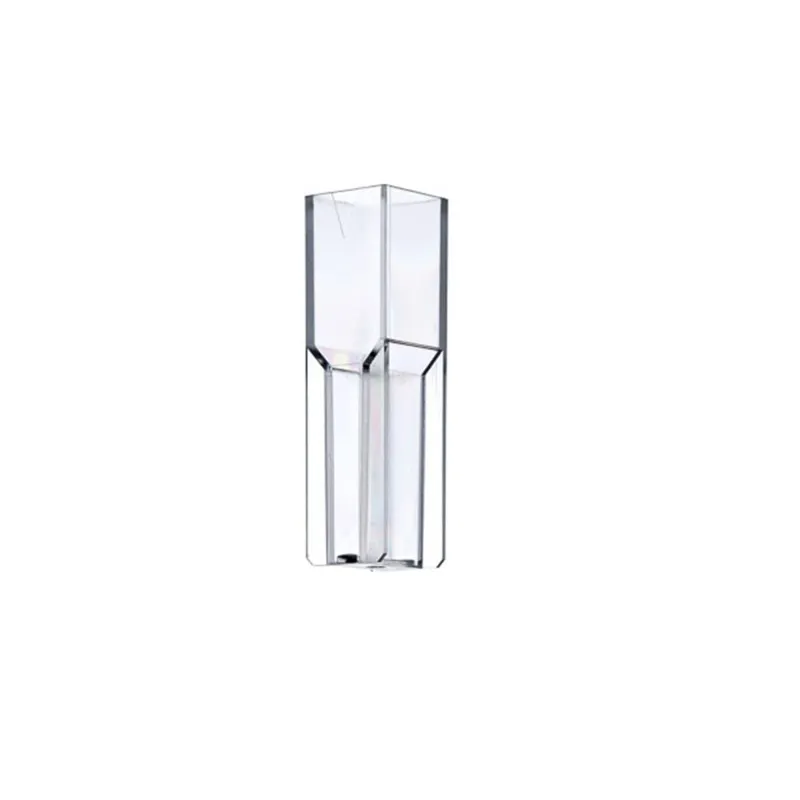
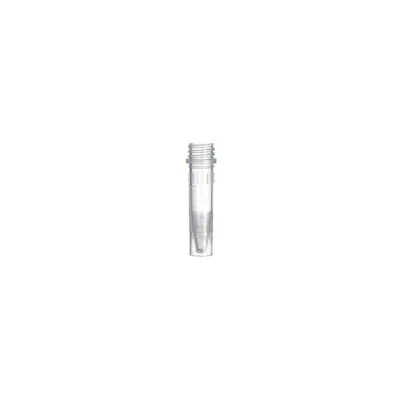
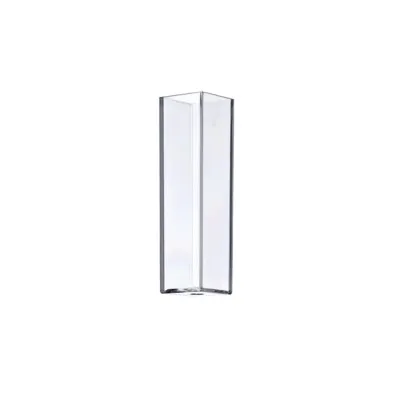
1.6ml Semi-micro Cuvette, Polystyrene

1.6ml Semi-micro Cuvette, Polystyrene

Quantity

  • Sterility: non-sterile
  • Characterised by minimal light scatter with high transmission
  • Volume: 1.6 ml
  • Applicable wavelength range: 340 nm to 900 nm
  • Length: 10 mm; width: 10 mm; height: 45 mm
  • Ideal for enzymatic determinations, since the very thin walls enable rapid and uniform tempering Manufactured from crystal clear polystyrene
  • Quantity: 1000 pcs
Go to Product Description

ASK A QUESTION

Please fill in the form below to ask a question about this product:

  100% Secure Shopping

100% Secure Shopping & Payment Gateway

  Express Delivery

We aim to ship all stocked items within 1-3 working days.

  Hassle Free Returns

Not 100% happy with your order? find out more about our returns policy.

  • Sterility: non-sterile
  • Characterised by minimal light scatter with high transmission
  • Volume: 1.6 ml
  • Applicable wavelength range: 340 nm to 900 nm
  • Length: 10 mm; width: 10 mm; height: 45 mm
  • Ideal for enzymatic determinations, since the very thin walls enable rapid and uniform tempering Manufactured from crystal clear polystyrene
  • Quantity: 1000 pcs

For Research Use Only. Not for use in diagnostic procedures, unless otherwise indicated.

G613101

Our standard delivery is 3-5 working days (where products are available) Monday to Friday, excluding public holidays when you order by 2pm. Details of our returns and cancellation policy can be found in our Returns Policy & Section 11 of our Terms and Conditions. For more information please contact us on 01924 444 577 or Email Us.

16 other products in the same category:

Meat Peptone

£596.13 vat excl.

£715.36 vat Inc.

Availability: Out of stock
Meat Peptone is for use in preparing microbiological culture media in a laboratory setting, and is not intended for use in the diagnosis of disease or other conditions in humans. Meat Peptone is a highly nutritious enzymatic digest of meat and may be used as an ingredient in culture media.

Neogen® Swab-Sampler with Buffered Peptone Water Broth

£105.66 vat excl.

£126.79 vat Inc.

Availability: Out of stock

Buffered Peptone Water Broth is used as a diluent or for non selective enrichment of microorganisms such as Salmonella species or E. coli from foods and environmental samples prior to selective enrichment and isolation. Microorganisms that may be present in a food product can be sub-lethally injured by food processing techniques and may not be recovered by direct selection techniques. Buffered Peptone Water Broth promotes the recovery of those microorganisms that may be injured.

Buffered Listeria Enrichment Broth - 500 g

£81.07 vat excl.

£97.28 vat Inc.

Availability: Out of stock
Buffered Listeria Enrichment Broth is used for selective enrichment of Listeria spp and is not intended for use in the diagnosis of disease or other conditions in humans. Listeria monocytogenes, described first in 1926 by Murray, Webb, and Swann, is an extensive problem in public health and food industries. Evidence from outbreaks of listeriosis has indicated that the principle route of transmission is via consumption of foodstuffs contaminated with Listeria monocytogenes. Implicated vehicles of transmission include turkey, frankfurters, coleslaw, pasteurized milk, Mexican style cheese, and pate. Listeria spp. are ubiquitous in nature, being present in a wide range of unprocessed foods as well as in soil, sewage, and river water. Buffered Listeria Enrichment Broth, a modification of the formula by Lovett et al., was developed after subsequent work concluded that enrichment properties can be improved by increasing the buffering capacity of the medium with the addition of Disodium Phosphate. Listeria spp. grow over a pH range of 5.0 - 9.6, and survive in food products with pH levels outside these parameters. Listeria spp. are microaerophilic, Gram-positive, asporogenous, non-encapsulated, non-branching, short, motile rods. Motility is pronounced at 20°C. Identification of Listeria is based on successful isolation of the organism, biochemical characterization, and serological confirmation.
Availability: Out of stock
Tryptic Soy Broth, Modified with Novobiocin is used for the selective enrichment of enterohemorrhagic E. coli in foods in a laboratory setting. Tryptic Soy Broth, Modified with Novobiocin is not intended for use in the diagnosis of disease or other conditions in humans. The first major outbreak of E. coli O157:H7 was in 1982 and traced to contaminated hamburgers. Other known sources of infection include sprouts, lettuce, salami, unpasteurized milk, juice and/or swimming in or drinking contaminated water. Tryptic Soy Broth, Modified with Novobiocin is used to enrich food samples suspected of having low levels of EHEC during pathogen testing.
Availability: Out of stock
  • Yeast and mould results in 48-60 hours.
  • Proven as reliable as DRBC and DG-18 spread plate methods, as well as acidified PDA and YGC agar pour plate methods
  • Can be used with both low and high water activity foods
  • Eliminates the need for the labour intensive, multiple plates spread plate technique
  • Versatility for air, swab or surface contact environmental sampling
  • Available in packs of 50 or 500 Plates
  • *Free delivery only available to UK Mainland addresses

TPC Plate count agar Dipslides

£11.69 vat excl.

£14.03 vat Inc.

Availability: 50 In Stock
  • Slide Format: Large Pushfit
  • Agar (Side 1): Plate Count + Neutralisers (On Black Slide)
  • Detection (Side 1): Total Count
  • Agar (Side 2): Plate Count + Neutralisers (On Black Slide)
  • Detection (Side 2): Total Count
  • Shelf Life: 6 Months
  • Storage Temp.: 8 - 15 C
  • Incubation: 35 C - 24 - 48 Hrs
  • 10 Dipslides per box
  • Minimum Order Quantity: 10 boxes

HC Agar Base - 500 g

£105.27 vat excl.

£126.32 vat Inc.

Availability: Out of stock
HC Agar Base is used with Tween 80 (Polysorbate 80) for the enumeration of molds in cosmetics in a laboratory setting. HC Agar Base is not intended for use in the diagnosis of disease or other conditions in humans. Methods for isolating molds from cosmetic products require incubation for 5 - 7 days using traditional agar media. In 1986, Mead and O’Neill described a new medium, HC Agar, for enumerating molds in cosmetic products. The formulation of HC Agar decreased incubation time to 3 days at 27.5 ± 0.5°C for molds. HC Agar Base, based on the HC Agar formula of Mead and O’Neill, is supplemented with Tween 80 (Polysorbate 80) to prepare HC Agar.