-
Hygiene Monitoring
add remove
- Luminometers
- Hygiena® EnSURE™ Touch
- Hygiena® SystemSURE™
- Neogen® Clean-Trace™ LM1
- Surface ATP Swabs
- Hygiena® SuperSnap®
- Hygiena® UltraSnap®
- Neogen® Clean-Trace™
- ATP Water Swabs
- Hygiena® AquaSnap® Total ATP Water
- Hygiena® AquaSnap® Free ATP Water
- Neogen® Clean-Trace™ Water - Total ATP
- Neogen® Clean-Trace™ Water - Free ATP
-
Diagnostic Tests
add remove
-
Lab Equipment
add remove
- Autoclaves add remove
- Balances & Weighing Equipment add remove
- Blenders & Homogenisers
- Homogenisers
- Stomachers
- Cabinets add remove
- Centrifuges add remove
- Colony Counters & Molecular Detection
- Gas Analysis & Monitoring add remove
- Glass Washers
- Hotplates & Stirrers add remove
- Incubators add remove
- Inspection Equipment
-
Meters
add remove
- Anemometers
- Conductivity Meters
- Damp Meters
- Density Meters
- Dissolved Oxygen Meters
- Electrodes & Probes
- Hydrometers
- Hygrometers
- Ion Specific Meters
- Kits
- Meter Accessories
- Moisture/Damp Meters
- Multi-parameter Meters
- pH Meters
- Pocket/Portable Meters
- Pressure Meters
- Rheometer
- Salinity Meters
- Turbidity Meters
- Viscometers
- Microscopes add remove
- NIR Instruments
- Ovens add remove
- Photometers
- Handheld Photometers
- Spectrophotometers
- Refractometers
- Refrigeration & Freezers add remove
- Rotary Evaporators add remove
- Shakers, Rockers & Mixers add remove
- Thermometers add remove
- Titrators add remove
- Water Baths add remove
-
Lab Consumables
add remove
- Bottles & Containers add remove
- Buffers, Reagents & Chemicals add remove
- Cuvettes, Tubes & Vials
- Detectable Consumables add remove
- Disinfectants & Decontaminants add remove
- Electrodes & Probes add remove
- Filtering & Dispensers add remove
- Microbiological add remove
- PPE add remove
- Sample Handling add remove
- Sample Transfer add remove
- Test Paper & Strips
- Cleaning Supplies
- PPE add remove
-
Brands
add remove
-
- 100% Chef
- A&D
- Adam Equipment
- Advanced Scientific
- Advantech
- AGC
- Alicat
- Analox
- Aqualab
- Asecos
- Astell
- Astell Scientific
- Atago
- Aurora Scientific
- Barky
- BD
- Bellingham & Stanley
- Binder
- Biochrom
- BRAND
- BriskHeat
- BST
- Buchi
- Burkle
- CE International Trading
- Chem-Tainer
- Clearline
- Clifton by Nickel Electro
- Clifton Food Range
- Cole-Parmer
- Cole-Parmer SamplePrep
- CoolMed
- Corning
- Dansensor
- Decon
- Delvo
- Detectamet
- Digi-Sense
- Dimanco
- Discovery
- DWK Life Sciences (Kimble)
- Dwyer
- Dynalon
- Elma
- Endecotts
- Eppendorf
- Esco
- ETI
- EUTECH
- Funke Gerber
- Gem Scientific
- Gemini
- Genesys
- Genlab
- Geotech
- Gerhardt
- Gilson
- GiroVap
- Glas-Col
- Grant Instruments
- Greiner Bio-One
- Guest Medical
- GVS
- GVS Filter Technology
- GVS FILTER TECHNOLOGY UK
- Hach
- Hadron
- Haier Biomedical
- Hanna Instruments
- HeroLab
- Honeywell
- Horiba
- Hydrosense
- Hygiena®
- IDEXX
- IK
- IKA
- InnovaPrep
- Integra
- Jaytec
- Jenway
- JIM Engineering
- Johnson Analytica
- Justrite
- Keck
- KNF
- Labcold
- Labglass
- Liebherr
- LMS
- Lovibond
- Lynd Products
- Medline Scientific
- Merck
- Meter
- Mettler Toledo
- Miele
- Milwaukee Instruments
- Minebea Intec
- Monmouth Scientific
- Motic
- MSE
- MWE
- Neogen®
- Nordic Labs
- Ohaus
- Olympus
- Oxoid
- PDI
- Powerblanket
- Prestige Medical
- Priorclave
- Purite
- Pyrex
- QMP
- Retsch
- Rotronic
- Rubbermaid
- S. Murray & Co
- Sampling Systems
- Sartorius
- Schaller
- Scienceware
- SciMed
- Seward
- SGL
- Shimpo
- SLS
- SLS Chemicals
- Snyder
- Solotech
- Solus
- Special Ingredients
- Sterilin
- Steris
- Stomacher
- Stuart
- Sychem
- Testo
- Thermo Electron LED
- Thermo Scientific
- Thermo Scientific Nalgene
- TSC
- Turbovac
- Tygon
- Unigloves
- Veolia Water Purification Systems
- Vickers Lab
- Vikan
- Virkon
- Vorwerk
- W.S. Tyler
- Waters
- Watson-Marlow
- Whirl-Pak
- Wildco
- WTW
- Xylem
- YSI
- Zahm and Nagel
- Zeulab
-
- New Products & Offers add remove
-
Knowledge Hub
add remove Knowledge Hub add removeMIXOLOGY add remove

List of products by brand Johnson Analytica
Johnson Analytica (Johnsons Test Papers) has been manufacturing easy to use rapid tests since 1938 providing fast and accurate results you can trust. Their products cover everything from simple pH testing, water analysis, production processes and measurements of special food parameters.
There are 13 products.

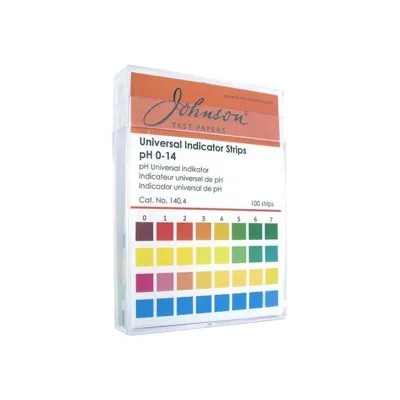
Universal Indicator Strips pH 0-14 (100 Strips)
£6.88 vat excl.
£8.26 vat Inc.
Availability: 324 In Stock
- Strips can be held in the specimen until the final colour change is observed, they can be used consistently with minimal risk in weakly buffered solutions
- Colours can be matched accurately with the colour chart as there is no cross-contamination between the pads on the strip.
- No specimen contamination
- Slim packaging provides portability and safety
- Nothing to prepare before use
- Consistent batch to batch measurements against accurately printed colour charts

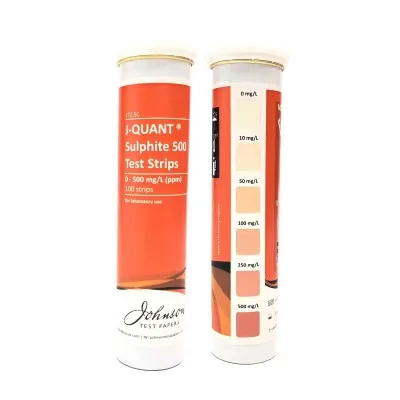
Availability: Out of stock
- Graduation: 0-10-25-50-100-250-500 mg/L 100 strips/pk
- Measurement of total sulphite requires further sample preparation
- Sulphite is utilised as an oxygen scavenger in process and boiler water, sulphite levels therefore need to be frequently monitored to prevent over treatment
- Also used for food analysis e.g. fruit juice testing, sulphurated foods (e.g. fresh and dried fruits), shellfish, crustaceans and minced meat products which use sulphur based products to prolong shelf-life
- Used to monitor production and quality of wine
- Compatible with sulphite, bisulphite and metabisulphite ions
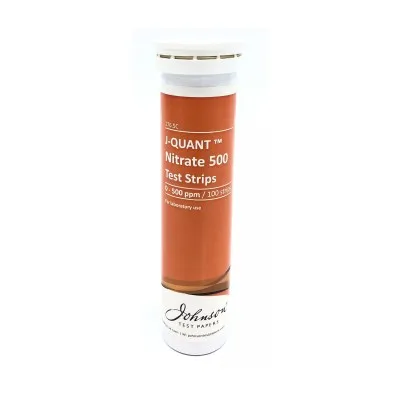
Availability: 1 In Stock
- Graduation: 0-0.5-1-5-10-25 mg/L Nitrate
- 100 strips/pk
- This test measures low levels of nitrite used mainly in environmental analysis, surface water investigations and aquaristics
- This test determines the level of nitrite in boiling water and cooling water
- These strips can also be determine the concentration of nitrite in wine and seafood
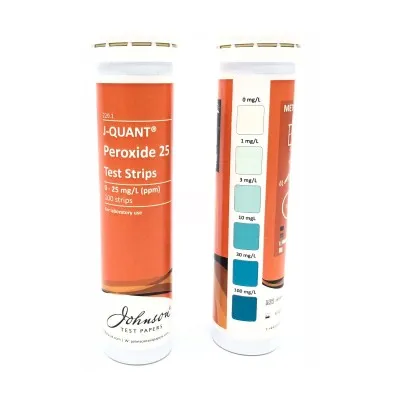
Availability: 3 In Stock
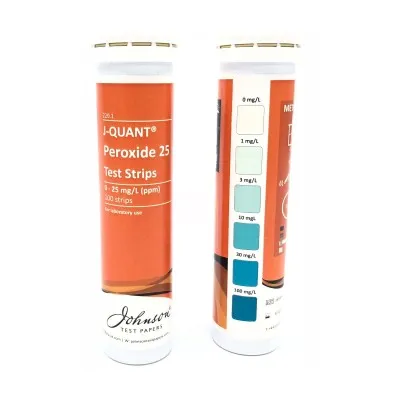
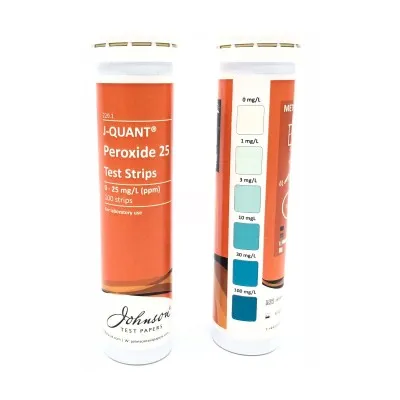
- Graduation: 0-1-3-10-30-100 mg/L Peroxide
- 100 strips/pk
- Useful for many applications, e.g. In chemical laboratories, organic solvents containing peroxide can be checked as they could explode upon heating.
- Soak the test pad in the solvent sample then allow to dry
- Add a drop of distilled/demineralised water and if the pad remains white then there is no peroxide present.
- Testing for residual peroxide where high strength disinfectants are utilised for cleaning such as the dairy industry, drinking water, pools and hot tubs
Availability: Out of stock
- Graduation: 0-500-1000-1500-2000 mg/L Peroxide100 strips/pk
- J-QUANT® Peroxide 25 test strips are an excellent choice for testing residual peroxide in production equipment levels after disinfection.
- The test strip will show a value of 0 mg/l if there is no peroxide in the sample therefore the process can move forward.
- The finished product is also tested for peroxide if it is made from a number of parts that have been disinfected with peroxide as a final check
Availability: Out of stock
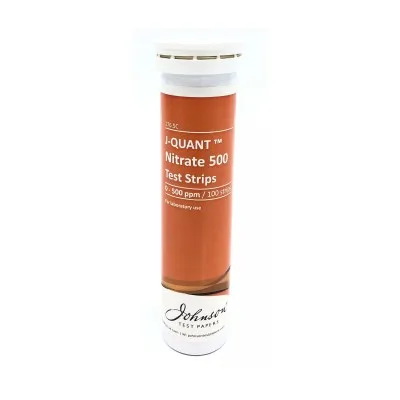
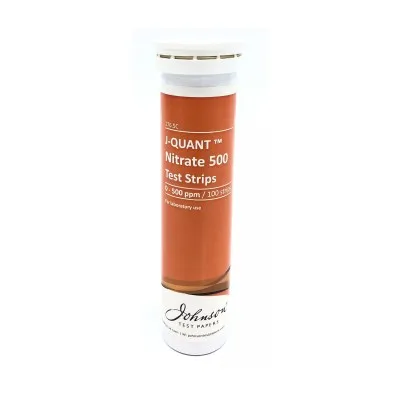
- Graduation: 0-10-25-50-250-500 mg/L Nitrate
- 100 strips/pk
- Regular testing of nitrate levels in food is important e.g. potatoes and in preservatives as high levels can affect the quality and consumer health
- Nitrate is derived from the decomposition of animals and plants
- Nitrate is more frequently measured than ammonium in ponds and aquariums to maintain the quality of water
- J-QUANT® Nitrate 500 ensures a rapid and safe way to check nitrate levels
J-QUANT Peracetic Acid 50, 100 strips
£19.29 vat excl.
£23.15 vat Inc.
Availability: 59 In Stock
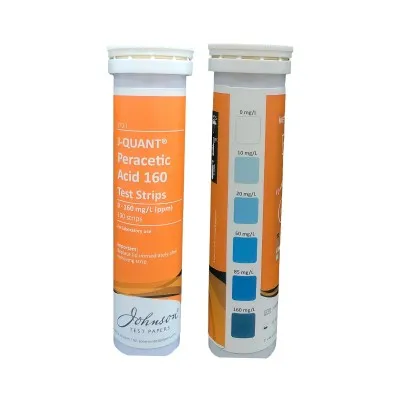
- Graduation: 0-5-10-20-30-50 mg/L
- PAA 100 strips/pk
- In the drinks industry, bottles and packages and disinfected using peracetic acid, which are then washed out to remove the residual disinfectant.
- These simple products can rapidly test for peracetic acid residue after rinsing to check that it has been removed.
J-QUANT Peracetic Acid 500, 100 strips
£22.89 vat excl.
£27.47 vat Inc.
Availability: Out of stock
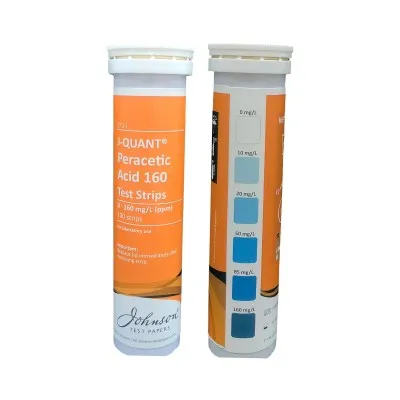
- Graduation: 0-100-150-200-250-300-400-500 mg/L
- PAA 100 strips/pk
- Used in healthcare, pharmaceuticals, cosmetics, agriculture and the food and beverage industry.
- In these industries the disinfectants are usually in concentrate form that need diluting before use.
- Due to its measuring range this test is suited to testing for the effective levels of peracetic acid in such disinfectants.
- Peracetic acid is unstable therefore frequent testing is required.
Availability: 25 In Stock
- Graduation: 0-2-5-10-20-40-80 mg/L Nitrate
- 100 strips/pk
- Colour changing
- Nitrite can provide an indication of contamination in the environment.
- Aquarium, industry, wastewater and drinking water analysis is, therefore, an appropriate list of examples where nitrite measurement is possible.
- Nitrite build up in aquacultures and fish farming through the breakdown of organic matter can impair the filtration units ultimately causing harm to the fish.
- It is very important therefore to test for nitrites in this environment.
Availability: Out of stock
- Graduation: 0-100-200-400-600-800-1000 mg/L Peroxide
- 100 strips/pk
- Peroxide based disinfectants usually come in concentrate form to save on shipping charges and require diluting before use.
- Depending on the industry and the disinfecting purpose different concentration levels are required
- Therefore these strips provide assurance that disinfection has taken place correctly by providing a semi-quantitative result
- Appropriate for measuring inorganic peroxides in aqueous liquids Also suitable for disinfecting and rinsing solutions e.g. food technology, laundries and in swimming pool water
J-QUANT Peracetic Acid 2000, 100 strips
£37.81 vat excl.
£45.37 vat Inc.
Availability: 1 In Stock
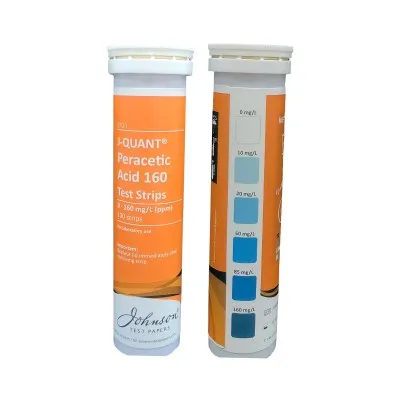
- Graduation: 0-500-1000-1500-2000 mg/L PAA
- 100 strips/pk
- Peracetic acid based disinfectants usually come in concentrate form to save on shipping charges and require diluting before use.
- Depending on the industry and the disinfecting purpose different concentration levels are required. Due to its measuring range this test is suited to testing for the effective levels of peracetic acid in such disinfectants.
- Therefore these strips provide assurance that disinfection has taken place correctly by providing a semi-quantitative result Peracetic acid is unstable therefore frequent testing is required.